Relic point Vietnam
Việt Nam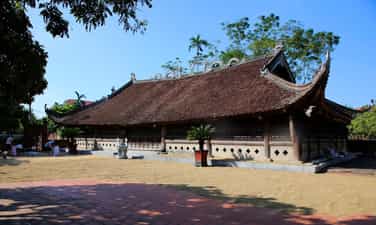
Dinh Noi
Noi communal house, Viet Lap commune, Tan Yen district is one of the famous large-scale, beautiful and famous ancient communal houses of Tan Yen land, past and present. Based on Han Nom sources still inscribed on wooden pillars in the communal house, it is said that the Noi communal house was built during the reign of King Le Hien Tong, the 34th year of Canh Hung (1775), on a high, open mound in the middle of the temple. Ly village and Noi village. However, because the communal house was built by people of 3 borders: Western, American, and Domestic of Noi village, that's why the communal house is called Noi communal house. In addition, when the communal house was completed, the villagers also named the communal house "Tien Dinh". Those two words are embossed on the top of the communal house's roof for everyone to see. If you want to visit the relic, visitors can go from Bac Giang city along National Highway 1A (old), cross Song Thuong bridge, turn right along provincial road 398, Bac Giang - Cao Thuong route, pass kilometer 11, turn right. Go right along the inter-village gravel road for about 1km to Noi communal house. Going back in time to find the history of Noi Communal House's construction, it is known that when they had prepared enough materials, Noi villagers welcomed carpenters from Bac Ninh to build the communal house. The workers competed with each other to show off their talents, so they left behind many beautiful wood carvings at the Noi communal house. Among them, a typical carving with the theme "rowing a boat to catch a stork" is based on the classic story: "If you keep the fish alive, the fisherman will benefit", depicting the scene of a stork pecking at a boy, and a boy holding his shell tightly to the stork's beak. So the old fisherman rowed out to catch both of them. There is also a carving of two mandarins sitting and drinking together, but behind each mandarin are two sword-wielding warriors standing right next to them. People call this carving "fighting while talking". The artist seems to want to say that in anything, we need to be calm and discuss carefully, then we hope to succeed. Again, these are crude carvings, but all the meanings are clearly visible. There is another painting depicting the scene of cavalry going into battle in an extremely strong and sturdy posture. In addition, in the communal house there are many carvings with delicate lines, each of which the artist reflects a current social reality with another profound meaning. The Noi Communal House was built to worship Saint Cao Son and Quy Minh, who were generals from the time of Hung King who had many contributions in repelling foreign invaders and protecting the peace of the country. The communal house also fully preserves precious worship objects such as: Dragon throne, tablets, palanquin set, and wooden bowls in the artistic style of the Le Dynasty (18th century). Over time, the Noi communal house was also restored and embellished through historical periods. Especially in the late 19th century, the communal house received attention and direction from the leader of the Yen The insurgent army - De Tham. This story is told by the elders: The front communal house faces southwest, the roof points straight to the Noi hamlet. People see "the corner of the family pond" as an unfavorable thing, causing people in the village to often quarrel and lose unity. Therefore, the villagers asked Mr. De Tham to change direction when Hoang Hoa Tham led the army to fight the French, having a close relationship with Noi village. The insurgents often came back here to meet and discuss with Mr. Doc Tuan (Ly village); Chanh Hoach (Noi village), Tong Lo (Temple of Literature). Knowing that, De Tham, with his prestige, stood up and turned the direction of the communal house to Noi village. From there, the communal house rotates to the Southeast. Also after the shooting of this communal house, the people built in front of the communal house two buildings, left vu, right vu, and a majestic ceremonial gate. Seen from afar, Noi village communal house stands tall in the beautiful natural scenery of a countryside village with green bamboo, ancient trees growing in the rain and sun next to the communal house's yard, and a fragrant green lotus pond radiating a cool scent. from the family pond makes the love for the countryside even more passionate. Today, through the ups and downs of history, the Noi communal house is no longer as intact as it was originally. Some items of the old building have been lost such as: The dance hall, the ceremonial gate, the entire wooden floor system of the communal house and many parallel sentences and horizontal panels are also gone. But basically, Noi Communal House still retains the appearance of an ancient communal house. The communal house currently has a linear layout including a large communal house with 5 compartments and 2 wings. In front of the communal house is a row of 3 rooms. Inside, the wooden frame system is linked in the way of stacking beams and gong stands. The communal house still preserves some traditional architectural features shown in the patterns carved on wooden structures, with the art of embossing, sinking, and carving channels that are very elaborate and meticulous. Decorative themes are presented in a variety of ways such as: Themes of four sacred animals, four precious animals, rowing boats to catch storks, storks,... typical of the style of the Le-Nguyen dynasties. The remaining system of precious worship objects in the communal house is: 1 set of palanquins, 2 altar thrones, 2 incense bowls of the Le Dynasty, 2 altar fruits, 1 mail tube... These artifacts are all very valuable original artifacts. in researching the history of monuments as well as the human land here. Every year, on January 10 and 11, Noi Lai villagers organize a big festival at the center of Noi communal house. During the festival, villagers organize sacrifices and solemn processions of books; There are poetry feasts, five trays of sticky rice made with the four words "peaceful world", there are rituals of singing ca tru to worship the Saints, singing tuong, singing cheo... to welcome people to dance at Lang Cao to come and enjoy the festival. At the same time, the association organizes many unique folk games such as: playing bridge, swing, cockfighting, wrestling... attracting many people from all over to attend. Therefore, the people of Noi village still have a song that says: "Dinh Noi has a festival to rob the bridge. Every November, every January comes." With typical architectural, artistic, historical and cultural values, it is also a place closely related to the Yen The uprising led by Hoang Hoa Tham (late 19th century - early 19th century). XX), Noi communal house was honored to be included in the list of 23 relics and historical relic clusters of Yen The uprising sites signed by the Prime Minister in Decision No. 548/QD-TTg dated May 10, 2012. recognized as a special national monument. This decision affirms the role and value of the monument and is a tribute from the state to the great contributions of our ancestors in creating a peaceful life for today's descendants. SOURCE Bac Giang Tourism Information & Promotion Center
Bac Ninh
2667 view
Rating : Special national monument

Ha Temple
Ha Temple in dual village 2B, Hong Giang commune, Luc Ngan district is an important relic with high historical, architectural and artistic value. The temple located in the middle of Ky Son hill has always been called Ha and Tu Ha temples. Along Highway 31, from the Bac Giang expressway intersection, turn right about 40km to the Kep and Hong Giang junction, turn right for more than a mile to reach the relic. Ha Temple worships Than Canh Phuc (ie Vu Thanh, Canh Nguyen, Canh Long or Than Dao Nguyen) who was the son-in-law of the Ly Dynasty and married to Princess Thien Thanh. In addition, Temple Ha from ancient times up to now not only worships one general of Vu Thanh, but also worships 6 other people who are all concubines and princesses of the Ly dynasty; Minister of the country Vu Tinh; National mother Thien Thanh Vu Thi Canh; Thuy Nhien, Princess Ly Thi Duoc; Binh Duong Princess Ly Thi Giam; Princess Yen Hoa Ly Thi Kien and Thanh Concubine Giap Thi Tuan. Ha Temple in Hong Giang commune is a type of famous memorial relic to commemorate not only one famous person, general Vu Thanh, but also 6 other famous people of the Ly dynasty. Ha temple is located in the southeast of Ho Ho village, on a large hill, arranged in the style of the letter Tam, including three not very large buildings: the lower temple, the middle temple and the upper temple. Next to it is the temple of the same name. All form an architectural unity located on the Luc Nam bank about half a kilometer. These three temples are located parallel to each other, but the middle and upper temples are connected to the temple by a tube. The house is simple, the structure between the rafters is in the style of single pillars. Ha Temple's architecture consists of 3 compartments, 2 grilles with 6 trusses and 24 large and small columns irregularly spaced between compartments. Behind the Lower temple is the middle temple consisting of 3 compartments and 2 compartments and finally the upper temple is also built with 3 compartments and 2 compartments. Located in the overall architecture of the temple is Tu Ha Pagoda. The pagoda's architecture is in the style of a nail. Around the temple area are a number of other relics associated with the temple and annual festivals including puppet ponds, drum mountains, gong mountains, flag fields, Duoc beach... which have made the relics richer and more lively. SOURCE ELECTRONIC INFORMATION PORTAL LUC NGAN DISTRICT, BAC GIANG PROVINCE
Bac Ninh
3542 view
Rating : National monument
Khanh Van Temple Relics, Chu town
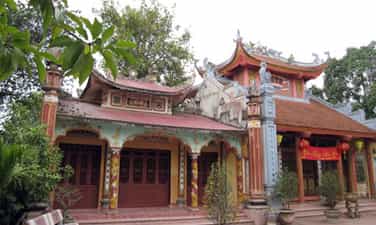
Khanh Van Temple is located next to the bank of Luc Nam river, on Tan Da hill, Ha Thi village, now Tran Hung Dao residential group, Chu town, Luc Ngan district. From Bac Giang, follow Highway 31 through Luc Nam district into Luc Ngan, a distance of nearly 40km to Chu town (district center). From here turn right about 500m to reach the temple. Khanh Van Temple is the name of the word (Sino-Vietnamese) engraved on the current temple roof, this is the main name of the temple. The name Quan Quan temple is the folk name after the character worshiped at the temple. The temple worships Vi Hung Thang of Luc Ngan, a general of the Tran Dynasty who helped Tran Trieu fight the Yuan-Mongol invaders in the 13th century. Vi Hung Thang is the son of Mr. Phuc Tinh and Mrs. Tu Duyen of the Vi family in Kim Son fabric village, Luc district. Ngan. He was compared with Yet Kieu, Da Tuong, Pham Ngu Lao and other generals. After being honored with the title of Duke, the people called it Quan Quan Temple. Khanh Van Temple is a type of memorial to famous people to recognize Vi Hung Thang, Luc Ngan's outstanding son, for killing the enemy and saving the country. The original Khanh Van Temple no longer exists. The current temple has just been rebuilt on the old ground, according to the elders, this is the land where he was buried, his grave. The temple is arranged in a nail style, in the middle of the temple there is a statue of Vi Hung Thang in a sitting position. In addition, the temple also worships generals of his time such as Yet Kieu, Da Tuong, Pham Ngu Lao... Next to the temple on the right hand side is Khanh Van Pagoda and other structures serving activities, festivals, worship... SOURCE ELECTRONIC INFORMATION PORTAL LUC NGAN DISTRICT, BAC GIANG PROVINCE
Bac Ninh
3390 view
Rating : National monument
Dong Tai village communal house
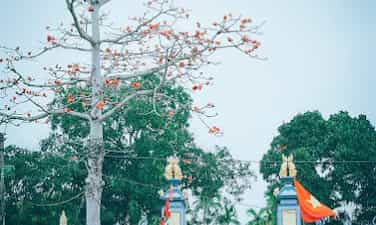
Before 1945, Dong Tai was the name of the commune, the commune had enough communal houses, pagodas and temples. In 1946, Dong Tai was a village of Thong Kenh commune (Gia Loc), Dong Tai communal house has since been associated with the village's name. Dong Tai Communal House was built in the center of the village, on a high, wide area of land, facing southwest, overlooking Nhi Ha River (now Thua River). According to the remaining genealogical records and through the words of the elders in the village, Dong Tai communal house worships 3 sisters of the Dao family: Dao Thi An, Dao Cong Hai and Dao Cong Thong, who had the merit of supporting King Due Vuong. The Thuc and Luong invaders defended the country... In the later years of resistance, Dong Tai communal house was a place associated with many important historical events of the locality and the province. In April 1995, Dong Tai communal house was recognized by the Ministry of Culture, Sports and Tourism as a national historical relic. "... Legend has it that Dao Cong Bot, from An Bang, Hai Dong district, was a deputy mandarin during the 18th Hung King's reign, held the position of minister of Chau Hoan (Thanh Hoa), and was later assigned by the king to the palace. Thuong Hong (Hai Duong town) was a minister. During his time in Thuong Hong, he married a female scholar named Nguyen, daughter of a famous family in Kenh Trieu, Gia Phu district (now known as Thuong Hong). Gia Loc). About 3 years Then Thuong Hong suddenly had a big flood, the Minister and the people had to build high huts to avoid the water. During the flood, suddenly 3 eggs floated to the front of the minister's hut. Seeing that it was strange, he picked them up Those 3 eggs were then taken away. Not long after, there was a heavy rain, thunder and lightning, the 3 eggs exploded like thunder and the flood water suddenly drained away, half happy, half worried, thinking that the 3 eggs were gone That egg is unusual, please order The soldiers held a ceremony to sacrifice the three magical eggs. That night, the minister dreamed of a man with a majestic appearance, riding on a Hoang Long (golden dragon) who gave him a brocade with a poem. available. Waking up, he saw the brocade placed next to him and was very happy. From then on, his wife became pregnant and gave birth to Dao Thi An, Dao Cong Hai and Dao Cong Thong. All three sisters are handsome, handsome, with unusual appearances, gentle personalities, and excellent martial arts skills. In particular, Dao Cong Hai and Dao Cong Thong have the power and strength to be able to scale mountains, block rivers, and walk on water waves like walking on land. People here consider three saints to come to earth. After their parents passed away, the three Dao sisters built a restaurant at the beginning of Kenh Trieu village to make a living. At this time, the Thuc dynasty sent a large army to invade Van Lang country. King Due Vuong and his officials directly went out to fight the enemy, but because of that and their forces were not balanced, they both fought and retreated. Arriving at Hau Bong commune, Gia Loc district, it was late afternoon, and the king issued an edict for his soldiers and officials to set up camp to rest. That night, the king sat down at Quang Minh pagoda, Hau Bong general. In his sleep, the king saw a tall man with neat clothes and hat approaching and saying: "I have obeyed the Emperor's orders and told the army to meet talented people to destroy the enemy." When I suddenly woke up, it was a dream and next to me was a brocade with a few verses written on it: The Emperor came down to help the army/ Went to Kenh Trieu to meet the Saint/ Dao Thi's brother was the one who helped save the country. people". The king immediately sent his troops to Kenh Trieu, invited the three Dao sisters back for an audience, and then appointed Dao Cong Hai as the acting head of international China; Dao Cong Thong is the General of the Army. The two men accepted the position, commanded a total of 300,000 soldiers and horses, divided into many columns to attack the enemy station. In just one battle, the Thuc enemy was defeated, and the survivors scrambled to escape. The country returned to peace, all people lived peacefully... Five years later, the Shu enemy's dream of invasion resurfaced, and they sent large troops to invade our country again. Dao Cong Thong and Dao Cong Hai asked the king to send troops to destroy the enemy. Grasping the enemy's weak point, the two generals arranged a covert attack at night, sending divers down to drill holes in the enemy's boat. Passive, the boat sank, the Shu army was once again defeated, and they fled back to the country in terror. After the complete victory, Dao Cong Thong and Dao Cong Hai did not stay at the court to enjoy the glory and wealth, but asked to return to Kenh Trieu to reside. On the way back, dark clouds suddenly appeared from somewhere, thunder and lightning were fierce, and in just a moment the two generals transformed into clouds and water. The king mourned the talented people and ordered the people here to build a temple and worship..." From the early days of the French colonialists invading our country, Dong Tai communal house was the headquarters of the Thong Kenh insurgent army, leading the people in the region to heroically resist the invasion of the French colonialists. The Thong Kenh insurgent army thrived, operating widely throughout the regions of Tu Loc, Kim Mon, Chi Linh, Chau Giang, and Hai Duong town, many times terrifying the French colonialists. In the years 1930 - 1945, when the revolutionary movement was rising and preparing for the uprising, Dong Tai communal house was the gathering place for representatives in the region, electing government agencies from provisional to official. The communal house is also the place where the commune's Party cell is established, and is the place for the cell to meet and direct resistance organizations and unions. Also at Dong Tai communal house, army units such as Tay Son, Bao Loc, B42, and 075 of the province came to practice. Later, Dong Tai Communal House was honored to be the place where the provincial and central leaders met, launched anti-American movements to save the country throughout the province and was the place to store important documents at that time... After many ups and downs of history, especially the years of resistance against the Dong Tai Court, which was much destroyed, the remaining offerings and harem remained. In the communal house, many artifacts of historical and artistic value from the Nguyen Dynasty are preserved such as: Long communal house, coffin, throne, hammock door, grand pagoda, scroll, sword worship... Continuing the heroic tradition of His father, today, the people of Dong Tai, in addition to being of one mind and working together to protect the relics, are also constantly studying, enthusiastically working and producing, contributing to building an increasingly rich, beautiful and civilized village. Source Electronic information portal of Gia Loc district, Hai Duong province.
Hai Phong
3743 view
Rating : National monument

Dau Pagoda.
Dau Pagoda has the Chinese name Sung Thien pagoda in Thi Duc village, Nhat Tan commune (Gia Loc). From afar, we saw a majestic pagoda appearing in the middle of a field along with a luxuriant area of trees. The pagoda is located on a high land, with unique architecture, bearing a strong Buddhist imprint. Around the pagoda there are lotus ponds and the winding Han River. According to the family tree, Dau Pagoda worships the saintly lady Pham Trinh Hien with the name Tien Dung, a princess who had the merit of helping Hai Ba Trung fight against the Eastern Han invaders. In the year 40, the Trung sisters raised a flag to rebel against the Han Dynasty. Once marching to this land, the two women stationed a military camp here. At night, they dreamed that someone called Princess Tien Dung, vowing to fight the enemy. The next day, the two women led their troops to battle on the Han River and won a resounding victory. The Trung sisters let the generals and local people celebrate and then issued a decree for the villagers to build a temple to worship Tien Dung, with the beautiful title Dieu Quang Hue Tinh Y Pham Trinh Hien, wife of Thuong class god. Over time, people built this place into a majestic pagoda that both worships Buddha and saints. The ancient Dau Pagoda had a scale of more than 100 rooms. The date of the pagoda's construction has not been determined, but based on the traces of bricks and tiles found, it can be determined that the pagoda was built at the end of the Ly dynasty and the beginning of the Tran dynasty. However, due to war and natural disasters, up to now, Dau Pagoda has lost many ancient architectural items. Currently, the pagoda has a nail-style architecture including 5 front halls and 3 back halls. The pagoda's roof has many reliefs with beautiful patterns of clouds, sun, and moon. In the pagoda there are 12 statues, made of wood, lacquered and gilded. In addition to the system of ancient Buddha statues, the harem also has a large temple, made of wood, exquisitely carved, and inside there is a statue of Princess Tien Dung. The statue is carved in a sitting position, calm and with a kind face. According to local elders, the entire statue system in the temple is carved from mulberry wood. Legend has it that the Han River next to the pagoda often floods. One time, the water was high, the flood came from upstream, carrying a large raft of mulberry wood with golden fibers like silk. Everyone thought it was a good omen so they picked it up and used wood to carve it into a statue. From then on, the pagoda was called Dau Pagoda. When visiting Dau Pagoda, we see that this place still preserves many valuable artifacts such as 2 steles of the Le Dynasty, some pieces of terracotta towers, terracotta pieces with phoenix heads, terracotta dragon heads, and patterned bricks and tiles. dating from the 13th-14th centuries. The most unique and special is the Tran Dynasty stele arranged right in front of the pagoda yard. The stele was created in 1331. The content of the stele was composed by Venerable Hue Van, a monk here, with about 1,180 words. This is a unique work of sculpture art. The stele is about 1.5m high, placed on the back of a rather large stone turtle. The stele's roof is moderately curved, and the stele's body has a border carved with dragons and vine flowers. The stele's forehead is decorated with many vivid leaves and lotus flowers, close to nature. Prominent on the front of the stele is a large cursive engraving of Buddha. Below the word Buddha are carved two images, on one side is a crane standing with a burning candle on its head. On one side is a humanoid demon wearing an incense burner. At the foot of the stele are carved patterns of water waves and mountains. On the back of the stele are engraved three Chinese characters "Sung Thien Pagoda", below are written the full names of those who donated fields and money to repair the pagoda. Not only unique in architecture and festivals, Dau Pagoda is also one of the important "red addresses". Dau Pagoda is a place that marks many revolutionary events. Before the August Revolution of 1945, the Viet Minh Front had a meeting at the pagoda to discuss seizing power and destroying the rice warehouses of the Japanese enemy in Thanh Mien district to give to the poor. In 1945, when the French invaded Hai Duong town, the Provincial Lien Viet Association chose the pagoda as the place to evacuate. In 1945-1950, Tay Son soldiers of Gia Loc district chose the pagoda as the location to open training classes. From here, our troops spread out towards Route 17 and Route 20 to conduct ambushes against the enemy during the resistance war against the French during the period 1949-1953. In the years 1951-1952, cadres, guerrillas of Pham Kha and Lam Son communes and soldiers chose the pagoda as a base to cling to the people to destroy the enemy, and destroyed the villains in Chuong and Ba Dong markets. Currently in the temple there is still a secret vault from the previous period. Dau Pagoda is a place to worship both Buddha and saints. The pagoda's traditional festival is held on the 8th to 10th day of the 8th lunar month. On this occasion, people and tourists from all over come to attend in large numbers. With its unique architecture and value, the pagoda was ranked as a national monument in 1992. Source: Electronic information portal of Gia Loc district, Hai Duong province.
Hai Phong
3665 view
Rating : National monument

Kham Lang Pagoda
In the cultural space of Bac Giang province, Kham Lang Pagoda is an ancient relic that currently preserves many historical cultural values and artistic architectural values, the most typical being the lotus stone incense burner of the Early Le Dynasty. Kham Lang Pagoda, Kham Lang commune, Luc Nam district, is ranked as a national architectural and artistic relic according to Decision No. 53/QD-BVHTT dated August 2, 1999 of the Minister of Culture and Information (now is the Ministry of Culture, Sports and Tourism). The pagoda is located in Ben village overlooking Luc Nam river and the majestic Huyen Dinh mountain range. This is an ancient pagoda that still preserves many historical, cultural and artistic architectural values. Currently, Kham Lang pagoda also preserves some documents and artifacts with the most typical historical and cultural value. is a lotus stone incense burner of the Early Le Dynasty. On the incense burner is engraved the words "Thuan Thien five years - Nham Ty year" (ie year of the Rat, the fifth year of Thuan Thien (King Le Thai To's reign - 1432). Overall, the surface of the incense altar's base looks like a court). In Bac Giang, besides Cao Pagoda, there is no place with such a unique incense burner. With its historical and cultural value, aesthetic value and uniqueness, the lotus stone incense burner at Kham Lang Pagoda has been recognized by the Prime Minister as a National Treasure in Decision No. 2382/QD-TTg dated December 25, 2015. It is known that Cao Pagoda is an artistic architectural work of the Tran Dynasty. In 1999, it was ranked as a national architectural and artistic relic. In 2013, the Vietnam Institute of Archeology coordinated with the Provincial Museum to organize an excavation and discovered many relics such as: Single lotus-nosed tiles, leaf-nosed tiles, cow tiles... dating from the Ly and Tran dynasties. to the Le and Nguyen dynasties. SOURCE: Bac Giang Tourism Information & Promotion Center
Bac Ninh
2755 view
Rating : National monument
Cao Thuong Communal House
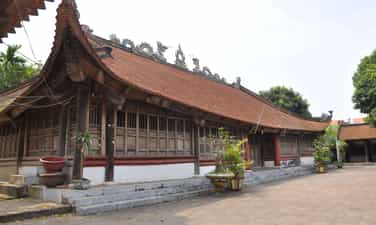
Cao Thuong communal house is located in the southeast of Yen Ngua mountain, Cao Thuong village, Cao Thuong commune, Tan Yen district (Bac Giang). It is a large, beautiful and splendid ancient communal house, the most majestic in the Tan Yen region. This place has imprinted the footprints of national hero Hoang Hoa Tham during the Yen The uprising 130 years ago. Cao Thuong Communal House consists of a 5-compartment, 2-room main house and 3-storey harem. This is a typical architectural work, characterized by the artistic style of the Le Dynasty in the 17th century. The communal house has an architectural style: the upper part of the house is the gong stand, the lower part of the house is the gong stand, and the lower part of the house is the 5-compartment and 2-compartment hall, which is tall, wide, majestic, and solemn. The middle space is up to 4.50 wide, the side space is nearly 4 meters wide, the main column has a circumference of more than 2 meters, a diameter of more than 70cm, enough to see the massive architectural scale of the communal house. The length of the communal house is more than 24m, the width is more than 14m, the area of the communal house is exactly one kilometer wide in the North, it is truly the largest wooden architectural work in this region. With 4 wide roofs, 4 curved blades, the roof is decorated with lemon flowers. Particularly, the gable is covered with a tiger face, originally from the communal house's renovations during the Nguyen Dynasty. As for the load-bearing frame structure, it includes 6 rows of column bases, a total of 48 columns with 8 extremely large columns, hardly seen in any communal houses in Bac Giang province today. This is the most outstanding architectural feature of Cao Thuong communal house, which is the many columns and large columns. All 8 main columns have 8 extra ends, these 8 columns are over 5m high, the military column is 3.5m high, and the porch column is also 2.7m high. The entire communal house floor is tiled with large bowls 40 x 40 x 5cm, 45cm higher than the communal house's yard surface. The bundle is full of bricks, 4 corners have 4 brick columns supporting the roof spreading out to nearly 2m. Creates a gentle, elegant look for the entire communal house's roof, which is inherently formal and majestic. Normally, village communal houses are built in the Dinh style, but Cao Thuong Communal House is built in the Nhi style with a two-room harem, 4 curved roofs, 4 rows of sturdy iron columns, and a strictly forbidden door. adjacent to the front and back roofs of the large communal house. This unique wooden architectural style has made the communal house both sustainable, strong, and massive while inside being tall and spacious while still being gentle, elegant, and beautiful. Currently, the communal house still preserves a number of ordinations with different dates, the two Cao Son - Quy Minh ordinations are: Superior God. The worship of the gods is held very solemnly and solemnly by the villagers. solemn with all the rituals: spring and autumn two periods: January 12 and August 20 (lunar calendar) both have book processions and jubilant sacrifices. From January 12 to 14, the two villages Cao Thuong and Dau Cau come to hold a big festival to process saints from Chanh communal house and Tren communal house to Cho communal house (Cao Thuong communal house is near the market so it is also called Cho communal house). The two villages held huge ceremonies and sang ca tru to worship the saint. Outside the communal house, there are many fun games: wrestling, chess, cockfighting, drum dancing... The festival includes tuong and cheo singing. People from far and near come to the festival and it has become a very sacred festival. During the years of fighting against the French colonialists, Hoang Hoa Tham often attended the Cao Thuong communal house and entertained the insurgents. When the French invaders burned Ton communal house, De Tham spent public funds and let the insurgents and people rebuild a new communal house. The communal house not only has architectural value but also carries a strong historical mark when the De Tham rebel army, our main force during the fight against the French colonialists, was stationed at this communal house. Especially during the Yen The uprising, the insurgent army led by Hoang Hoa Tham had a very close connection with Cao Thuong village and Cao Thuong communal house. Therefore, De Tham established a base on Yen Ngua mountain in the Cao Thuong communal house area. In 1890, the French colonialists learned that there were Mr. De's troops at Yen Ngua Mountain, so they organized a force to attack the insurgents. Defeated, they frantically burned down communal houses, pagodas and Yen Ngua mountain. During the second peace period between France and De Tham (1897-1909), De Tham helped people repair the communal house and rebuild the pagoda on the old pagoda's foundation. The historical evidence and heroic past of Cao Thuong communal house relics have been the pride of officials and people here. In addition to the unique architectural features and historical evidence, Cao Thuong Communal House is also known for its special market on the 2nd day of Tet every year, "Yin and Yang Market". According to the people of Cao Thuong village, Cao Thuong commune. (Tan Yen) is said to be special because the "Yin and Yang Market" only meets once a year, fixed on the 2nd day of Tet. People who go to the market are happy and mentally comfortable. They believe that it is an opportunity to do good and good deeds for the dead and their spiritual life will be more peaceful. With typical and unique values, Cao Thuong communal house was honored to be recognized by the Government as a special National Monument in 2012. SOURCE: Bac Giang Tourism Information & Promotion Center
Bac Ninh
2999 view
Rating : Special national monument

Hoang Hoa Tham historical relic site
Hoang Hoa Tham historical relic site is located in Phon Xuong town, Yen The district, Bac Giang province. This place is associated with the resounding victory of national hero Hoang Hoa Tham - the brown-shirted leader - who together with the people of Yen The raised an uprising flag against the French colonialists nearly 30 years (1884 - 1913). This is the largest and longest peasant uprising in the history of our Vietnamese nation against foreign invaders before the Party led it. The historical and cultural relic site of the Yen The peasant uprising has created a complex of historical relics of great value. With 23 relic sites, most of them are forts, communal houses, temples, pagodas and shrines spread across 4 districts (Yen The, Tan Yen, Viet Yen and Yen Dung). The Yen The uprising relic site is convincing evidence of the brave spirit and sacrifice of the De Tham insurgent army to regain independence and freedom. To recognize and honor those special values and meanings, on May 10, 2012, the Prime Minister signed Decision No. 548/QD-TTg classifying the relic as a special national monument. Yen The district has 9 points including: Phon Xuong fort, Ho Chuoi fort, Leo pagoda, Dinh Thep communal house, Thong pagoda, Hom fort, Thien Thai cave, Cau Khoai temple and The Temple. Among them, the center of the uprising was the Hoang Hoa Tham historical relic site in Phon Xuong town, Yen The district, Bac Giang province. 1. Oath Temple In front of us is the Oath Temple. The temple was built in the late 19th century using thatch, bamboo, and leaves. In 1897, when the second peace between the French colonialists and the Yen The insurgent army took place here, De Tham repaired the temple with ironwood architecture as we see today. This architecture is still fortunately still intact. After being renovated, De Tham often used this place to hold festivals to improve the spiritual life of the people. In particular, he often used this place to recruit insurgents and recruit talented people. Before each battle, he often had the insurgents gather to drink bloody wine and swear oaths here. In May 2012, the Prime Minister signed a decision to recognize 23 relics of the Yen The uprising as special national historical relics and The Temple as one of 23 special national historical relics. there. 2. Hoang Hoa Tham Monument Located right behind the The Temple is the monument of national hero Hoang Hoa Tham. The statue was initially made of concrete, then changed to bronze in 2013, created by author Anh Vu - a member of the Bac Giang Province Literature and Arts Association in 1984. The statue is 5.07m high, surface area 31m2, average thickness 2.0cm; The statue's pedestal is 2.1x2.1m in size, 0.32m high, surface area 7m2, average thickness 2.5cm. The statue weighs over 7 tons of solid bronze, with a value of over 4 billion VND, and most of the money for making the statue came from socialization. 3. Yen The Uprising Exhibition House The next item in the relic site that any visitor cannot help but visit is the Yen The Uprising Exhibition House. The exhibition house was built in 1984 and initially had a 1-storey architecture. It was later built and remodeled and has the 2-storey architecture it has today. The first floor displays an ethnographic corner of Yen The district. The second floor displays images and artifacts of the Yen The uprising, the most typical, largest and longest spontaneous peasant uprising of our nation in the late 19th and early 20th centuries ago. when the Communist Party of Vietnam was born. 4. Phon Xuong Fort Phon Xuong Fort, also known as Don Go, Don Cu, was built in 1894, guarding the only road leading to the insurgent base. This is the main headquarters of the Yen The insurgent army, the capital of the uprising, the starting place to expand the movement to localities. De Tham built Phon Xuong Fort as both a place to live and live for De Tham's family as well as for the insurgents, and at the same time it was also a meeting and discussion place between De Tham and contemporary heroes to discuss matters. fought the enemy to save the country (like Phan Boi Chau, Phan Chu Trinh, Le Van Huan, Nguyen Dinh Kien, Ky Dong...). In particular, this is where the second peace settlement between the Yen The insurgent army and the French enemy took place. After the uprising ended, Yen The people built the temple of Ba Ba - Hoang Hoa Tham's third wife in Phon Xuong station to commemorate her great contributions in the uprising. 5. Yen The Festival Yen The Festival is held on March 15, 16, 17 every year. This is one of the biggest festivals of Bac Giang province. The festival is an opportunity for people to express their respect and remember the merits of Hoang Hoa Tham, a talented general, the supreme leader of the Yen The peasant movement and the insurgent army who fought against the French colonialists. In 2013, Yen The festival was recognized by the State as a national intangible cultural heritage. SOURCE: Bac Giang Tourism Information & Promotion Center
Bac Ninh
3559 view
Rating : Special national monument

Duoi Temple
National historical site Duoi Temple is located in Thong Nhat commune, Gia Loc district, Hai Duong province. This is the place to worship the Queen Mother Empress Dowager Y Lan. Princess Ỷ Lan also had another name Queen Mother Linh Nhan. She was the concubine of Emperor Ly Thanh Tong and the mother of Emperor Ly Nhan Tong - two kings of the Ly Dynasty (in the 11th century). National mother Ỷ Lan is honored by history as a female masterpiece, talented in ruling the country. During her lifetime, she was twice appointed regent, and made great contributions to building the Ly dynasty and developing Vietnamese Buddhism. With nearly a thousand years of existence, Duoi Temple has experienced ups and downs, influenced by nature, rain, sun and war. Many items of the temple are seriously degraded. At the end of the 20th century and the beginning of the 21st century, the relic still retained construction items bearing the architectural imprint of the Later Le Dynasty (17th century) and the Nguyen Dynasty, with "quoc" style architecture, including: the buildings of Tien Te, Trung Tu and Hau Palace, two rows of Giai Vu connecting the two buildings of Tien Te and Trung Tu. In the grounds of the relic complex, there is also Quynh Hoa pagoda and a model house that is also seriously degraded. To meet the expectations and needs of cultural and religious activities of local people and tourists from all over, the Duoi Temple relic complex has been invested in repairing and renovating basic items, including: the pre-mortem buildings. , Trung Tu and Harem, two left and right corridors, inner gate and some auxiliary items. The Tieu Tieu Court consists of three compartments, with "first" style architecture with four main trusses. The system of columns, ends, and rafters are made of ironwood, with a "stack of beams, gong stand" structure and exquisite carvings. The temple's two temples of Tien Sa and Trung Tu are connected by two rows of ceilings, forming a closed space. The harem building has three rooms, including a forbidden palace room, decorated with an altar and a statue of Queen Mother Y Lan. In particular, Duoi Temple still preserves many valuable worship objects, offerings and antiques, such as four palanquin sets, a dragon communal house, four altar thrones, a set of precious bowls, two parallel sentences, a bronze incense bowl and two Stone art since the 17th century. Continuing the mark of ancient history, at the 1943 - 1944 relic, the Liberation Army propaganda team as well as the commune's self-defense team regularly organize military exercises to prepare for the national revolutionary climax like comrade Thieu. , comrade Tue (currently a retired officer and teacher). In August 1945, revolutionary cadres and the masses gathered to seize power in Gia Loc district and then confiscated the diplomas and seals of mandarins, tyrants, and bureaucrats, abolishing the government of feudal colonialists. The provisional government was established amid the joy and excitement of the people. In 1946, the French colonialists turned their guns back to invade our country, the Hai Duong squadron evacuated to the temple in time to direct the resistance. The commune's guerrilla team used the temple area as a military training site. In 1947, comrade Tran Dua, head of the police department, and the Viet Hung team returned to the temple to eliminate traitorous Vietnamese traitors. In 1948, the resistance committee of Cam Giang district and the Quang Trung army unit evacuated to the temple to work and practice. After that, the resistance committee of Thach Khoi commune evacuated to maintain its activities. At the relic site, secret tunnels were also dug to hide and protect officers and soldiers. It can be said that during the two resistance wars, Duoi Temple in Thong Nhat Commune was the base of the local resistance and a line of communication to the Viet Bac war zone. To commemorate her, every year the 12th day of the second lunar month is her birthday; and July 25 is the day of her death, local people organize festivals to recall the merits and career of Queen Mother Ỷ Lan for everyone to remember and study. Source Electronic information portal of Gia Loc district, Hai Duong province.
Hai Phong
3475 view
Rating : National monument

Last Temple
Last Temple is a place to worship An Nghia Dai Vuong Nguyen Che Nghia - a famous general of the Tran Dynasty, a son of Hoi Xuyen village, Gia Loc district, Hai Duong province (formerly Coi Xuyen commune, Truong Tan district, Hong Chau road). ). He was born into a famous family. Since childhood, he had extraordinary health, was good at riding horses, used long spears, was proficient in astronomy and war, and loved to recite poems and write poetry. Thanks to his intelligence and talent, and at a time when the Tran Dynasty needed talented people, he was drafted into the army under Pham Ngu Lao and participated in battles against the Yuan army and at the Chi Lang pass. Going into battle, he rode a horse and carried a spear into the midst of the enemy's army, winning every battle... When the enemy was defeated, he was appointed as a great general of Khong Bac, with the title Nghia Xuyen Cong. Nguyen Che Nghia was recognized as having a loyal, straightforward personality, not afraid of hardship, so he was considered a loyal and talented general of the Tran Dynasty. King Anh Tong loved him and married his beloved daughter, Princess Ngoc Hoa. When he was old, he returned to rest in his hometown of Hoi Xuyen. Currently, within the Cuoi Temple relic complex, there is also La Khoi pagoda, a teaching school (where An Nghia Dai Vuong Nguyen Che Nghia trained martial arts and banditry for soldiers), an astrology pond (where he watched astronomy to weather prediction only for people doing business) and the tomb area. The existence to this day of these relics is a rare and proud thing for the Cua village people. The mausoleum of Princess Nguyet Hoa (the saint's wife), the mausoleum of Cong Sung Phuc (the saint's son) and the mausoleum of Phat Tich (the saint's parents) are made of stone built in the style of a dragon court, surrounded by stone walls, to this day. dating back hundreds of years. As for the Saint's mausoleum, located in the north of the village on a high hill, the 2-acre-wide "white elephant sucks water" built of bricks from the Tran dynasty is still intact. In front of the mausoleum, there is a gate with a marigold symbol on it, on both sides of the entrance there are dragons, and behind the mausoleum there is a white elephant. In the mausoleum there is a stone stele engraved with Chinese characters. Roughly translated: The tomb of a mandarin who entered the inner city, a Thai lieutenant, a lieutenant of the Tran dynasty, a deity named Nguyen, named Che Nghia, a villager and princess Nguyet Hoa who were ordained as emperors... History has gone back a long way, but with 31 ordinations in 300 consecutive years (21 ordinations in the Le dynasty, 2 ordinations in the Tay Son dynasty, 8 ordinations in the Nguyen dynasty), the people of Coi Xuyen are always proud of their homeland's hero. Cuoi Temple Festival takes place for 3 days, from 26 to 28 of the 8th lunar month, originating from the death anniversary of General Nguyen Che Nghia (August 27). Even though more than 600 years have passed and many ups and downs of history have passed, both the ceremony and the festival at Cuoi Temple still retain their own unique features. Source Electronic information portal of Gia Loc district, Hai Duong province.
Hai Phong
3072 view
Rating : National monument