
 vn
vn en
en ja
ja ko
ko zh
zh


See 9 world cultural and natural heritage sites in Vietnam

UNESCO has just recognized Ha Long Bay - Cat Ba Islands, located in Quang Ninh province and Hai Phong city, as a world natural heritage. So far, Vietnam has 9 heritage sites recognized by UNESCO as world natural and cultural heritages, including 5 cultural heritages, 3 natural heritages and 1 mixed heritage.
Vietnam has just recorded the 9th world natural heritage recognized by UNESCO, the Ha Long Bay Complex - Cat Ba Archipelago, located in Quang Ninh province and Hai Phong city. This event brings Vietnam's total number of world heritage titles to 9, including 5 cultural heritages, 3 natural heritages and 1 mixed heritage.
>
Hue Monuments Complex

An ancient, poetic corner of Hue city. Photo: Hoang Le
In December 1993, Hue Monuments Complex was officially added to UNESCO's list of World Cultural Heritage. This is Vietnam's first cultural heritage recognized by UNESCO as a World Cultural Heritage.
For nearly 400 years (1558 - 1945), Hue was the capital of 9 Nguyen lords (16th - 18th centuries) in Dang Trong, the capital of the Tay Son dynasty (late 18th century), then the capital of the unified country under the 13th Nguyen kings (1802 - 1945).
The ancient capital of Hue today still preserves tangible and intangible cultural heritage containing many symbolic values for the intelligence and soul of the Vietnamese people. According to researchers, among the ancient capitals of Vietnam, Hue is the only place that still preserves the overall integrity of royal architecture and art, with a system of citadels, palaces, shrines, temples, mausoleums...
Ha Long Bay
In 1994, Ha Long Bay was recognized by UNESCO as a world natural heritage for its aesthetic value and was recognized a second time for its geological and geomorphological value in 2000.
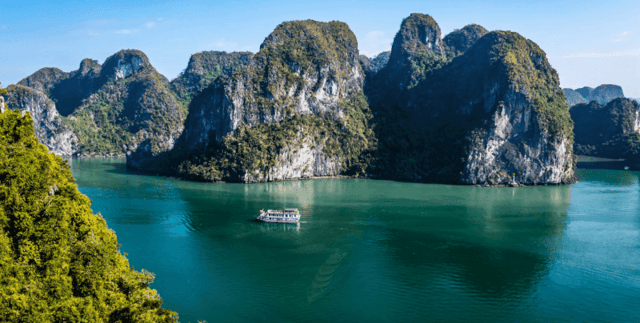
Photo: Vuong Loc
The island population in Ha Long Bay has two main types: limestone islands and schist islands. Although the number of islands in Ha Long Bay is very large, no island is the same, creating a unique landscape that only Ha Long has.
Based on this shape and people's imagination, the islands here have been given very familiar and simple names such as Human Head Island, Trong Mai Island, Dragon Island, Ong Su Island, Chopstick Island... Besides, some islands are also named after folk legends such as Bai Tho Mountain, Trinh Nu Cave, Tuan Chau Island or unique features on the island such as Ngoc Vung Island, Kien Vang Island, Monkey Island...
My Son relic site
According to the Department of Cultural Heritage, My Son Cham relic site is located in a narrow valley, in My Son village, Duy Phu commune, Duy Xuyen district, Quang Nam province. The temple tower at My Son represents Champa religious architecture.
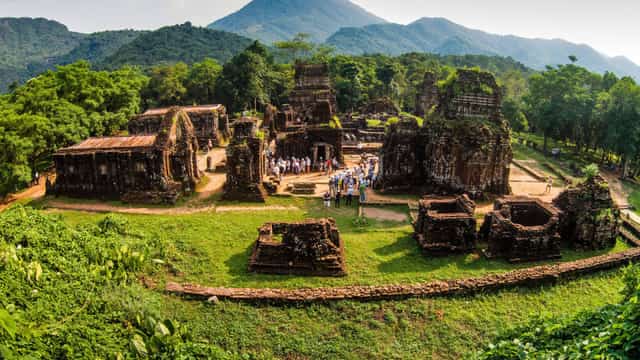
Photo: My Son Heritage Management Board/www.disanvanhoamyson.vn
Most temples and auxiliary buildings are built of bricks with sophisticated techniques. Decorative motifs on stone pillars along with round statues and sandstone reliefs carved based on Hindu myths... The harmonious combination with sophisticated carved motifs on the brick walls outside the tower has created a lively My Son temple complex, bearing the characteristics of Champa art styles.
My Son relic site was officially recognized by UNESCO's World Heritage Committee as a World Cultural Heritage in December 1999.
Hoi An Ancient Town
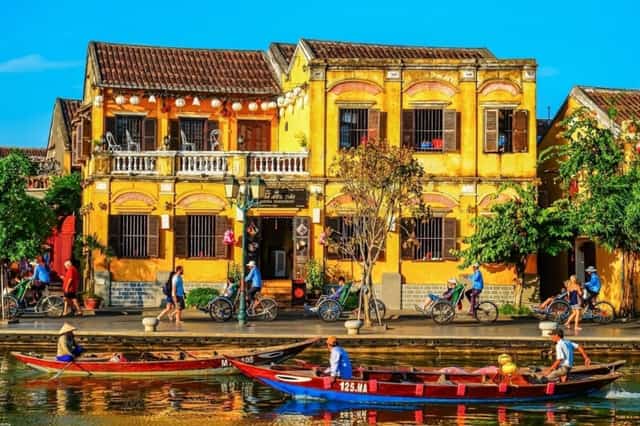
Hoi An ancient town seen from above. Photo: Hoang Le
Hoi An ancient town is a famous tourist city of Quang Nam province. In addition to cultural values through diverse architecture, Hoi An also preserves a massive intangible cultural foundation. As a type of traditional port town in Southeast Asia, rare in the world, through many ups and downs of history, Hoi An still retains almost its original state with about 1,360 relics.
Hoi An is famous for its traditional, harmonious architectural beauty of ancient houses, walls and roads. Although hundreds of years have passed through many events, this place still retains its ancient beauty, silence, moss on every tiled roof, row of trees...
Phong Nha - Ke Bang National Park

The beauty of Hang Va belongs to Phong Nha - Ke Bang National Park. Photo: Ryan Debooth
Phong Nha - Ke Bang National Park and surrounding areas include part of Bo Trach, Tuyen Hoa and Quang Ninh districts. Most of the core area of Phong Nha - Ke Bang National Park is limestone mountains. With intensely divided karst terrain and evergreen tropical vegetation on limestone mountains, Phong Nha - Ke Bang National Park has biological diversity and unique geology and geomorphology.
Phong Nha - Ke Bang area has a complex of more than 300 large and small caves, diverse and spectacular, known as the "Kingdom of Caves", a place with many strange and attractive things, a paradise for cave scientists, explorers and tourists.
Thang Long Imperial Citadel
Thang Long Imperial Citadel Relics. Photo: TTXVN
Thang Long Imperial Citadel is a complex of relics associated with the history of Thang Long - Hanoi. This massive architectural work was built by dynasties during many historical periods and became the most important monument in the system of Vietnamese monuments.
According to the National Tourism Administration, along with the nation's history over the past 10 centuries, the Imperial Citadel of Thang Long - Hanoi has undergone many changes. Here, archaeologists have unearthed a large number of ceramics that were everyday items used in the royal palace over many periods of time. In addition, many bronze coins and ceramics from China, Japan, West Asia... found here are evidence that Thang Long was once a center for cultural exchange with countries in the region and received the quintessential values of humanity.
Ho Dynasty Citadel
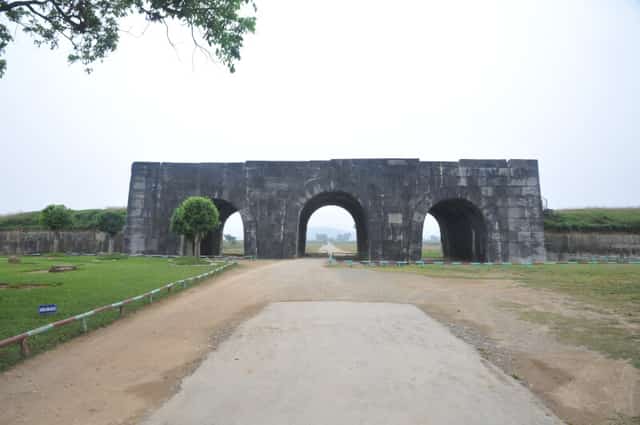
Ho Dynasty Citadel is a solid citadel with unique stone architecture. Photo: Nguyen Phong
Ho Dynasty Citadel, also known as Tay Do Citadel in Vinh Long and Vinh Tien communes, Vinh Loc district, Thanh Hoa province, is one of the most unique stone architectural works in Vietnam and the world. The entire city wall and four main gates were built of blue limestone slabs, finely chiseled, square, and stacked tightly on top of each other without the need for adhesives.
The project was built by Ho Quy Ly in 1397, also known as Tay Do to distinguish it from Dong Do (Thang Long - Hanoi), once considered the capital and socio-political and cultural center of Dai Ngu country under the Ho dynasty. With outstanding global values of culture, architecture and history, in June 2011, the Ho Dynasty Citadel was recognized by UNESCO as a World Cultural Heritage.
Trang An scenic complex
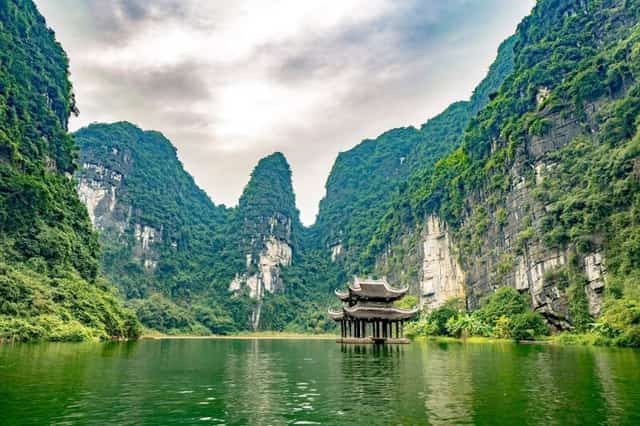
Trang An scenic complex has been registered by UNESCO as a world heritage site, becoming the first mixed heritage of Vietnam and Southeast Asia to be recognized by UNESCO. Photo: Vuong Loc
Completing all the criteria of culture, aesthetic beauty, and geology with outstanding global values, Trang An Scenic Landscape Complex has been registered by UNESCO on the list of world heritage sites, becoming the first mixed heritage of Vietnam and Southeast Asia to be recognized by UNESCO.
Trang An scenic complex has an area of 6,172 hectares in Hoa Lu, Gia Vien, Nho Quan districts, Tam Diep town and Ninh Binh city, Ninh Binh province. Trang An scenic complex includes three adjacent protected areas: Hoa Lu ancient capital historical and cultural relic site, Trang An - Tam Coc - Bich Dong scenic area and Hoa Lu special-use primeval forest.
Ha Long Bay – Cat Ba Islands
Ha Long Bay - Cat Ba Archipelago is recognized by UNESCO as a World Heritage Site because it has areas with natural beauty including limestone islands covered with vegetation; sharp peaks of limestone mountains rising above the sea surface along with related karst features such as domes and caves.
Lan Ha Bay, belongs to Cat Ba archipelago. Photo: Vuong Loc
With 1,133 limestone islands of various shapes and sizes (775 limestone islands of Ha Long Bay and 358 limestone islands of Cat Ba Archipelago) covered with rich vegetation on sparkling emerald water, Ha Long Bay-Cat Ba Archipelago appears like a chess board made of precious stones; Young, peaceful water and smooth white sand beaches.
With the interference of mountains, forests and islands, Ha Long Bay - Cat Ba Archipelago has a high level of diversity in Asia, possessing 7 adjacent tropical and subtropical marine - island ecosystems, developing successively. The first inter-provincial world heritage site of Ha Long Bay - Cat Ba Archipelago registered by UNESCO will be an important premise, contributing experience and practice, towards building an inter-provincial and inter-border heritage management model.
Quang Ninh 9347 view
Update day : 24/09/2023
Source : Sài Gòn Tiếp Thị Affiliate links



Monuments close by
See all
Bach Dang Historical Relic
Bach Dang Historical Relic is located in Quang Yen Town and Uong Bi City. This is the place marking the event when the Tran Dynasty's army and people achieved a famous victory - the Bach Dang Victory, defeating the Yuan Mongol invaders in 1288. In the history of our nation's defense of the country, Bach Dang River has witnessed our army and people three times resoundingly defeat the mighty Northern invaders, all with wooden stakes planted in the Bach Dang river bed. That was Ngo Quyen's Bach Dang victory in 938; 981 by Le Hoan and the peak was the Bach Dang victory in 1288 by Hung Dao Dai Vuong Tran Quoc Tuan. Bach Dang River has become a historical river, Bach Dang stake has become a symbol of the tradition of fighting foreign invaders by waterway of the Vietnamese people. After more than 700 years of sedimentation by the river, the pile pile was deep under layers of mud. It was not until 1953 that people digging soil to build dikes discovered the Bach Dang piles. At first, people did not have the knowledge and awareness to protect cultural heritage, so many piles were pulled up to make rafters and straw piles. After many excavations, archaeologists discovered hundreds of stakes, mainly ironwood, 2.6 to 2.8 m long and 20 to 30 cm in diameter, inserted straight. The average distance between piles is from 0.9 m to 1.5 m. Bach Dang stake yard relic area (including Yen Giang pile yard, Dong Van Muoi pile yard, Dong Ma Ngua pile yard). Yen Giang stake yard relic has an area of about 3,000m2 located at the mouth of Chanh River with a rectangular shape of about 120m long and about 20m wide. Yen Giang stake yard was ranked a special National Monument in 2012. After that, the monument was zoned for protection, an introductory stele was erected, and the access road was embellished to create favorable conditions for tourists to visit. This is also an address for students to learn about history and serve their studies. Currently, Yen Giang pile yard still has about 300 trees in the ground. At the relic site, the pile yard is filled with water to the pond for conservation. Near the Yen Giang stake yard is the Van Muoi copper stake yard with an area of about 6,000 square meters located at the mouth of the Rut River, in Nam Hoa ward, discovered by the people of Quang Yen during the process of farming and digging ponds. After the survey and excavation in 2005. Subsequent archaeological excavations found a total of nearly 200 stakes, showing that wooden stakes planted vertically and diagonally in the Van Muoi field area belonged to many types of wood used. both trunk and branches. The diameter of each pile is from 7 - 10 cm, the pointed part is only about 25 - 30 cm. However, the density of stakes here is very thick, usually 40 - 60 cm apart, some stakes are only 10 - 30 cm apart. According to researchers, this is the southern half of the Bach Dang stake field, while the northern half is the Yen Giang stake field. Because between the two piles there is a strip of high rocky dunes, when the tide is low, the boat cannot cross and is forced to go close to the shore. Therefore, Tran Hung Dao chose a position to place stakes on both sides of the dune to form a V-shaped defense line tightly covering the throat of the Bach Dang River to block the enemy's retreat, creating a glorious victory in the above battle. Bach Dang River in 1288. The pile was then buried under a layer of mud for better preservation. Also in Nam Hoa ward, Quang Yen town, the Ma Ngua copper pile yard with an area of about 2,100m2 was discovered and surveyed and excavated in 2010. This is the third pile yard in the Bach Dang pile yard. Located at the mouth of the Kenh River, about 1 km south of the Van Muoi copper pile. The pile yard is 70 m long and 30 m wide, with stakes of many types of wood with diameters from 6 - 22 cm densely arranged in strips like a wall. The three piles of Yen Giang, Dong Van Muoi and Dong Ma Ngua have created large, complex, hidden underground piles under the water, blocking the escape route to the sea, helping to destroy and capture 600 warships with 40,000 people. Yuan-Mongol generals during their third invasion of our country in 1288. Today, the Bach Dang stake yard relic area in Quang Yen town has been surrounded by a protective embankment. Some of the piles were retrieved and the remaining piles were preserved in an on-site display pit. However, most of the Bach Dang piles at this relic have rotted and broken tops, and the body of the pile is still stuck in the mud, but this is an extremely important evidence of the historical battle on the Bach River. Dang year 1288. With the special historical, cultural and scientific values of the relic site, on September 27, 2012, the Prime Minister signed a decision to classify the Bach Dang Victory historical relic site in 2012. 1288 is a special National Monument. Bach Dang Festival takes place from March 6-9 of the lunar calendar with many solemn rituals and rich festive activities, held at all points in the relic site. To honor the value of our nation's great victory day and commemorate those who sacrificed their lives in the Bach Dang battles. Source: Quang Ninh Electronic Newspaper
Quang Ninh
8511 view
Rating : Special national monument
Yen Tu Historical and Scenic Area
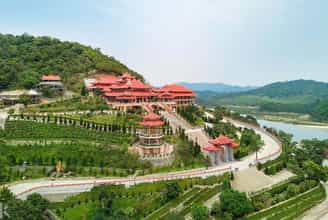
Historically, Yen Tu has always been one of the Buddhist centers of the country, associated with many ancient architecture, built through different historical periods (Ly, Tran, Le, Nguyen). Geographically, Yen Tu is a low mountain range, belonging to the Dong Trieu arc system, a geological region formed in the Quaternary period, with bedrock types, such as sandstone, gravel and ancient alluvium... Geography The area's complex geology and geology have created magnificent landscapes, such as Ngu Doi waterfall, Vang waterfall, Silver waterfall, Heaven's Gate, Tung street, bamboo forest, Yen Tu mountain peak..., where there are unique architectural features. Traditional architecture seems to blend into majestic nature. Yen Tu area has a total natural area of about 2,686 hectares, including 1,736 hectares of natural forest, typical of the Northeast forest ecosystem, which also preserves many rare genetic resources of animals and plants... Interspersed with nature is a system of pagodas, temples, towers... Along the paths leading to the pagodas, temples, and towers, many pine trees are often planted. In this area, there are still more than 200 giant pine trees, belonging to 4 rare groups, planted about 700 years ago. In addition to ancient larch trees, the bamboo forest here is also famous since ancient times... Bamboo is a unique product of Yen Tu, symbolizing the vitality, purity and elegance of nature. Perhaps, that is also the reason why Tran Nhan Tong chose this place to practice and named "Bamboo forest", or Truc Lam, to name the Zen sect he founded. Yen Tu Festival is a spring pilgrimage festival, starting on January 10 every year and lasting for 3 spring months. The Yen Tu area includes several major Buddhist sites and architectures such as: 1. The ancient Bi Thuong Pagoda was built in the Later Le Dynasty, on a Nhat-shaped architectural foundation, and has been restored and embellished many times in history. Worshiping the Eighteen Arhats. 2. Suoi Tam Pagoda was built at the foot of the mountain, next to the bank of Bath stream. 3. Cam Thuc Pagoda Located on the left side of the road into Yen Tu. 4. Lan Pagoda and Giai Oan Pagoda were both built during the Tran dynasty. 5. The Hon Ngoc tower cluster is located on a fairly large, flat mound of land, including three stone towers and one brick tower. 6. Hue Quang Tower Garden now has only 64 towers and tombs, of which 40 towers were newly restored in 2002, 11 stone towers, 13 brick towers, some towers have collapsed, leaving only traces. 7. Hoa Yen Pagoda was built during the Ly Dynasty and was embellished many times throughout history. The pagoda is located halfway up the mountain, facing southwest. 8. Ancient Thien Dinh Am was originally a special ancient tower in Yen Tu, standing alone, behind Hoa Yen Pagoda. The tower is built of red bricks with green glaze, the surface is embossed with many strange patterns and animal faces. 9. One Roof Pagoda is nestled on the side of a high mountain. Half of the pagoda is hidden deep in a mountain cave, the other half is exposed to the outside and has only one roof. 10. Am Thung and Am Duoc are now only ruins. 11. Bao Sai Pagoda is located on the mountainside, facing southwest. 12. Van Tieu Pagoda is located on the mountainside. On both sides of the pagoda there are 2 high mountain ranges, forming a throne that surrounds the pagoda. To the right of the temple there is a stream. 13. Dong Pagoda is located on the highest peak of Yen Tu mountain, cast from bronze. The special historical and cultural values of the relic site have made Yen Tu a sacred place in the spiritual life of Vietnamese people. To affirm the special value of the monument, the Prime Minister decided to classify Yen Tu historical and scenic relics as a special national monument on September 27, 2012). Source: Department of Cultural Heritage
Quang Ninh
8223 view
Rating : Special national monument

Archaeological relic of Hon Hai Co Tien
Historical and archaeological relic Hon Hai Co Tien belongs to group 65, Bach Dang ward, Ha Long city. From 2001 to present, Quang Ninh Museum has cooperated with the Vietnam Institute of Archeology and the Vietnam Museum of History to survey, excavate and discover many relics bearing typical marks of the late period of Vietnamese culture. Ha Long culture (Late Neolithic period) to the Dong Son Culture period (Metal Age) dating from 4,000 to 2,000 years ago. Here, scientists have unearthed 91 artifacts, 1,000 scientific specimens including production tools, daily utensils, jewelry, beliefs... with ceramic, bone, and stone materials; a burial site with 46 ancient human remains, some of which are relatively complete. The remains were buried bundled with burial items. Quang Ninh Museum also surveyed 4 locations in the valley and foothills, and collected 294 artifacts and over 20,000 scientific specimens including bronze, stone, bone, and ceramic materials such as fish hooks, axes, chisels, jewelry. Here, scientists discovered many pieces of bronze molds of the Dong Son Culture along with pieces of bronze slag used to cast axes, spears, spears... In Area I, Quang Ninh Museum also discovered a population of fossil corals that may belong to the Devonian - Carboniferous period (about 400 million years ago today). Along with archaeological value, Hon Hai Co Tien Relic also has primeval rocky forest with many precious primates and reptiles such as golden-haired monkeys, salamanders, geckos... and a rich flora system. Natural resources of rocky mountain forests such as tea tree, Phat Du mountain, Ha Long orchid, Golden flower Venus, Ha Long Thien Tue... The recognition of the Hon Hai Co Tien relic as a National Monument has contributed to enhancing the cultural value of the World Heritage Site of Ha Long Bay and the important historical position of Quang Ninh with the ancient culture of Ha Long, in Northeast region of Vietnam. At the same time, the monument also creates a unique cultural tourism product right in Ha Long city. Source: Department of Culture and Sports of Quang Ninh province
Quang Ninh
8202 view
Rating : National monument

Tran Dynasty Relic Area in Dong Trieu
Tran Dynasty historical relic site in Dong Trieu belongs to An Sinh, Trang An, Binh Khe, Thuy An communes. Currently, this is the relic that retains the most imprints of the glorious Tran Dynasty. In the year At Dau, 1225, Ly Chieu Hoang ceded the throne to her husband Tran Canh, marking the transfer of power from the Ly dynasty to the Tran dynasty. From here, the Tran dynasty ruled the country for 175 years, with 12 kings, creating the most glorious dynasty in our country's history. The Tran Dynasty (1225 - 1400) with martial arts and literature, opened a heroic era in the history of building and defending the country. According to documents, the Dong Trieu area was the Tran family's first settlement. Afterwards, this land was given by King Tran Thai Tong to his brother Tran Lieu as a thang moc hamlet. When reigning, each dynasty paid attention to two issues: Duyen Trach was the land where the capital was located, and Am Trach was the place where temples and mausoleums were located. Besides Thang Long continuing to be chosen as the capital, the Tran Dynasty also built and developed two cultural centers and two mausoleum areas in the east and south of the capital. Many researchers have identified Dong Trieu as a major cultural and religious center, along with Thang Long - the political and economic center and Thien Truong Long Hung, the birthplace of the Tran Dynasty. The ancient name of Dong Trieu was An Sinh, but it was only during the reign of King Tran Du Tong that the name was changed, and it became the current Tran Dynasty historical relic site. This is a special national relic area including mausoleums, temples, pagodas, and towers with 14 relics spread out. This is a sacred holy land imbued with historical and cultural spirit and is the original hometown of the Tran Dynasty. Since the 13th century, the Tran Dynasty built Thai Mieu, worshiping the Three Patriarchs of Tran, which is the most important relic site. By the end of the 14th century, many tombs of King Tran were moved to Dong Trieu. The Tran Dynasty historical relics area includes 3 groups, the temple relics group, the mausoleum relics group and the pagoda relics group. Temples and mausoleums are attached to the Tran Dynasty's temples. Along with building mausoleums, the Tran Dynasty also built temples and shrines to worship the predecessors, and many pagodas also sprang up accordingly. But at that time, Dong Trieu only played the role of a mausoleum area and had not yet become the Buddhist center of Dai Viet. It was not until King Tran Nhan Tong became a monk that he went to Yen Tu mountain to practice and founded the Truc Lam Zen sect. He unified the previously existing Zen sects and the entire Buddhist church of the Tran dynasty under one umbrella. During this period, Dong Trieu became an important Buddhist center. The Tran kings built here a dense system of temples, tombs, pagodas and towers in a large landscape area stretching up to the slopes of Yen Tu mountain. Ngoa Van Ho Thien Pagoda is where the Buddha King Tran Nhan Tong preached sermons, and is also a place associated with the cause of propagating Buddhism in Dai Viet, training monks at a higher level. On Ho Thien Pagoda there is also a 7-storey stone tower whose architecture is still a mystery to researchers, attracting many researchers and history lovers from everywhere to visit and study. rescue. Quynh Lam Pagoda is considered the first Buddhist university in Vietnam, possessing a Buddha statue of one of the Four Great Elements of An Nam. The tower garden in the pagoda and the stone tower tombs of Zen masters have unique architecture, a typical cultural heritage not only of Quang Ninh province but of the whole of Vietnam. Over time, natural disasters destroyed, war ravaged, many ancient works in the Tran Dynasty historical site in Dong Trieu are only ruins. However, those ruins still retain their value in the hearts of the people. An Sinh in the past, Dong Trieu today is where the Tran Dynasty kings expressed the fallen leaves ideology of returning to the roots of the Vietnamese people. The things that still exist or even the things that are only left underground are still timeless heritages that not only carry the historical value of the famous dynasty but also demonstrate the 700 years of existence of pure Vietnamese Buddhism. Source: Quang Ninh Tourism Newspaper
Quang Ninh
8042 view
Rating : Special national monument

Cua Ong Temple Historical Relic
Cua Ong Temple (also known as Dong Hai Linh Tu or Duc Ong Temple) is located in Cua Ong ward, Cam Pha city, Quang Ninh province. The temple worships the main deity, Quoc Khao Hung Nhuong Dai Vuong Tran Quoc Tang, in addition to worshiping Cuu Thien Vu Empire Phu Nhan Vu Hung Dao Dai Vuong and his family and generals. Through historical records, it can be confirmed that Cua Ong Temple was built and existed for more than 100 years. At the beginning, the temple was just a small hermitage made of thatch, bamboo, and leaves; In 1907 - 1916, the temple was restored; In 1916, the Upper Temple, Middle Temple, Lower Temple, and pagoda were built; In 1946, the Lower Temple and Upper Temple continued to be renovated and embellished; In 2014, the master plan of the Cua Ong Temple relic site was approved with an area of 18,125 hectares; By 2016, Trung temple was built and completed in 2017. In addition, there is also Cap Tien temple (people call it "Cua Suot Girl" temple) built during the Nguyen Dynasty. Cua Ong Temple was initially built to worship Tran Quoc Tang, after building additional Ha, Trung and Thuong temples, Cam Son pagoda... specifically as follows: Ha Temple area: includes Mau Temple and Trung Thien Long Mau Temple Mother Goddess Temple: worships three thrones of the Holy Mother (Mother Thuong Thien, Mother Thuong Ngan, Mother Thoai Phu), Jade Emperor, Nam Tao, Bac Dau, Four Adoring Her, Five Worshipers, Mr. Hoang Muoi, Mr. Hoang Bo , Mr. Hoang Bay. Trung Thien Long Mau Temple: worships Trung Thien Long Mau and worships three girls, Cua Suot boy and Cua Suot girl (two people like Kim Dong and Ngoc Nu, symbolizing yin and yang who always follow and protect the mother, protect the land and waters of Cua Suot, protect the temple where Trung Thien Long Mau is located). Currently, Cua Ong Temple still preserves the ordained religion for Cam Pha commune, Hoanh Bo district, Quang Yen province, worshiping Trung Thien Long Mau deity, dated March 18, the 2nd year of Khai Dinh (1917). The stone stele at Ha Temple was built in the year of the Rat (1948). Trung Temple area: worships Kham Sai Dong Dao Tiet Che Hoang Can, who was instrumental in suppressing foreign invaders from the North and defending the East Sea. Here, the Son God and the Water God are also worshiped because Trung Temple is located on the Cam Son mountain range, in front of the East Sea, people in the estuary area as well as boats passing by pray for the help and support of the gods. the Mountain God, the Water God. Thuong Temple area: includes Thuong Temple, Quan Chau Temple, Quan Chanh Temple, Tran Quoc Tang pagoda and tomb. Thuong Temple: worships the main god, Quoc Khao Hung Nhuong Dai Vuong Tran Quoc Tang, in addition to worshiping Cuu Thien Vu Empire Phu Nhan Vu Hung Dao Dai Vuong and his family and generals. * Hung Nhuong Dai Vuong Tran Quoc Tang (1252 - 1313) He is a national hero, the third son of Hung Dao Vuong Tran Quoc Tuan. Currently, a number of ordinations for Hung Nhuong Vuong Tran Quoc Tang are still kept at the temple, affirming his merits, as well as the history of formation and existence of Cua Ong temple. In addition to the miracles, appearances, and ordination records of Hung Nhuong Vuong Tran Quoc Tang, at Cua Ong temple, stone stele, wooden signs, horizontal plates, and parallel sentences have been preserved, through which the main deity of the temple has been identified. is the National Archaeologist Hung Nhuong Dai Vuong Tran Quoc Tang. * At the same time, at Thuong Temple, there are also historical figures such as: - Hung Dao Dai Vuong Tran Quoc Tuan: Hung Dao Dai Vuong, after helping the Tran Dynasty expel the invading Yuan invaders, eliminating great disasters for the nation, was revered by the people. After his death, he became Thuong Tien Cuu Thien Vu Emperor. - General Pham Ngu Lao; Da Tuong; Yet Kieu; Nguyen Khoai; Huyen Du; Cao Mang; Do Hanh; Hung Vu Vuong Nghien, Hung Tri Vuong Hien, Hung Hien Vuong Uat; Tran Binh Trong; Pham Ngo; Tran Thi Kien; Tran Quang Trieu; Tran Quoc Toan; Ha Dac; Truong Han Sieu; Le Phu Tran; Nguyen Dia Lo; Tran Khanh Du; Do Khac Chung; Vi Hung Thang; Nguyen Che Nghia; Holy Mother Thien Thanh (Nguyen Tu National Mother); Princess Quyen Thanh (Vuong Co First); Princess Dai Hoang; Thuan Thanh (Preserved from the Queen) Quan Chanh Temple: worships Quan Chanh, Quan Tuan Tranh and Quan Supervisor. Quan Chau Temple: worships Quan Tri Chau, who governs the Cam Pha region. Tomb: based on the legend and spirit of Cam Pha village, Cam Pha canton, Cam Pha district, Quang Yen province, recorded in 1938, the tomb of Hung Nhuong Vuong Tran Quoc Tang is only symbolic, a place where shows the people's respect towards Him, as well as that of a son towards his father. Pagoda: worships Buddha, Jade Emperor, Nam Tao, Bac Dau, Quan Am Tong Tu, Thuong Tue Trung, Duc Ong, Duc Thanh Hien... like other traditional temples of Vietnam. Cap Tien Temple: worships a young lady - the daughter of Tran Quoc Tang (also known as "The Cua Suot Girl"), the Chief Mandarin and other gods, then worships Buddha, Jade Emperor, Nam Tao, and the North. Dau, Innate Holy Mother. The miracles, identities, and ordinations of the gods are still preserved at Cua Ong Temple, becoming a valuable historical document for generations of descendants to learn about the process of building and defending the country of the Tran Dynasty. Cua Ong Temple relic site has gone through wars and ups and downs of history, but still preserves many ancient architecture (gable walls on both sides of the tube and the Harem) and ancient statues dating back to nineteenth century. With the above special value, Cua Ong Temple Historical Relic was ranked as a Special National Monument by the Prime Minister on December 25, 2017. Source: Department of Cultural Heritage
Quang Ninh
7975 view
Rating : Special national monument
Nearby tourist attractions
See all
Ha Long Bay
Ha Long city, Quang Ninh province, about 180 km from Hanoi, is known as the tourist paradise of the North. With a convenient location, modern infrastructure and developed transportation system, Ha Long city attracts tens of millions of domestic and foreign tourists each year. Ha Long Bay has an area of 1,553 square kilometers including 1,900 large and small limestone islands with vivid shapes. The bay has been honored many times by UNESCO as a world natural wonder and is a tourist destination not to be missed. The weather in Ha Long is divided into two distinct seasons: summer - from May to October and winter - from November to the end of April. The average annual temperature is 25ºC, quite ideal for outdoor tours. With diverse vegetation and favorable climate, you can travel to Ha Long Bay at any time of the year. However, according to experience traveling to Ha Long Bay, you should avoid stormy times in July and August to have the most complete trip. Regarding travel costs from Hanoi to Ha Long city or Ho Chi Minh City. Ho Chi Minh to Ha Long, you can refer to below: Regarding accommodation costs, depending on the area you choose, the room price will have a certain difference. Ha Long room prices usually range from 200,000 VND/night to 2,000,000 VND/night. Food costs also depend on the number of dishes you order, and the number of people eating. However, in general, the cost per meal is not too high. If you eat seafood in a restaurant, the cost is from 150,000 - 500,000 VND/person. The cost of visiting Ha Long Bay is about 250,000 VND - 2,000,000 VND depending on the type of tour you choose. Normally, people who have experience traveling to Ha Long Bay on their own will choose to visit the bay by boat for 250,000 VND/person. It can be seen that the cost for a trip to Ha Long Bay is not fixed but depends on the individual's schedule and entertainment needs of each tourist. However, if you choose to travel on your own, the most suitable cost to eat, rest and visit places for about 2 days will range from 3,000,000 VND to 5,000,000 VND. According to Ha Long Bay travel experience, there are many convenient means of transportation to visit every corner of Ha Long city: Motorbike: You can easily rent a motorbike to explore Ha Long city by yourself at a reasonable price. However, for many tourists, you should ask in advance the price of the car rental and remember the time to return the car to avoid "unjustly losing money". Bus: Ha Long has a bus system connecting famous tourist destinations. The average bus ticket price in Ha Long city is about 7,000 - 10,000 VND/way. Electric vehicle: Electric vehicle is quite a popular means of transportation, especially in the center and tourist destinations in Ha Long. According to Ha Long Bay travel experience, the price of a tram ticket is about 500,000 - 900,000 VND for one trip. You can use this service from 7:00 a.m. to 10:00 p.m. every day. Taxi: This is a convenient means of transportation and suitable for most tourists. Tourist destinations in Ha Long Bay are not far from each other so the cost of traveling by taxi is not a problem. Taxi prices in Ha Long Bay range from 5,000 - 11,000 VND/km, depending on the car company and distance traveled. Ha Long Bay has majestic and poetic natural beauty with thousands of large and small islands and many unique caves. The bay is also recognized by UNESCO as a world natural wonder and attracts a large number of tourists every year. When going around the bay, you can admire beautiful natural scenery with beautiful destinations such as Sung Sot cave, Con Coc island, Dragon Eye island, Ti Top island, Ngoc Vung island,... Bai Chay Beach is an artificial beach located next to Ha Long Bay. This is the most beautiful beach in the city, with clear blue water and fine white sand stretching nearly 1,000 meters. According to Ha Long Bay travel experience, you can freely swim, check in and experience water games. Located on Tuan Chau island, Tuan Chau tourist area attracts tourists with its beautifully decorated and poetic space. When coming to Tuan Chau, you should attend a water music performance and have fun at the outdoor amusement park or the newly opened dinosaur park. Kayaking leisurely on the cool water, hidden behind the Luong cave mountain range will make you feel extremely peaceful. After visiting Luong cave, you can walk to Ti Top island and watch the sunset with friends on a yacht. Quang Ninh Museum is considered a miniature model of Quang Ninh province, a place that preserves the culture and peaceful life of Ha Long people. Young people traveling to Quang Ninh all have "lifetime" photos at this attraction.
Quang Ninh
8241 view
May to October

Tuan Chau Island
Tuan Chau Island is a super famous tourist resort destination in Ha Long city, Quang Ninh. Located about 2km from Ha Long city center, the island has an area of about 400 hectares with many beautiful landscapes, beaches, and tourist areas for tourists to visit. Tuan Chau Island is a super famous tourist resort destination in Ha Long city, Quang Ninh. Located about 2km from Ha Long city center, the island has an area of about 400 hectares with many beautiful landscapes, beaches, and tourist areas for tourists to visit. Tuan Chau Island is a beautiful beach tourist destination, so the ideal time to visit will definitely be in the summer. The time from March to October will be the most suitable time, at this time the sky is clear, the sea water is cool blue, the beach is white sand and the sunshine is extremely beautiful. However, you should note that the summer period from May to July will have very high temperatures, possibly up to 40 degrees Celsius. For those of you with weak health or families with children and the elderly, remember to be careful. kidney. When traveling in the summer, don't forget to bring sun protection items for yourself. Coming to Tuan Chau island, you can participate in activities such as swimming. Swimming is definitely always the first activity when coming to Tuan Chau island area. With a super beautiful artificial beach of up to 5km, fine white sand, cool blue sea water, Tuan Chau beach will definitely be a great medicine to forget daily fatigue. You can immediately dive into the cool ocean water, freely swim or participate in exciting activities. In addition, you can participate in the Tuan Chau water music program. Tuan Chau Island Water Music Performance Palace is a venue for many water music shows combined with extremely spectacular lighting. This place is designed with very special architecture inspired by the Roman school. The area of the Water Palace is 15 hectares with 12,000 seats. The programs here are very professionally invested, on average a performance will last about 40 minutes. And there are many other attractive activities.
Quang Ninh
7295 view
From April to December

Co To Island
Co To is an archipelago of about 50 islands located in the east of Quang Ninh province with an area of 46.2 km². Co To island district currently has 1,500 households, with nearly 6,000 people. The Co To archipelago has more than 50 islands, large and small rocks, of which Big Co To and Small Co To are the two islands with the most beautiful beaches. This is also a place with great potential for tourism development. Coming to Co To, you can visit the following places. First, Cau My Stone Beach. This is a place known as the paradise of love and youth amid the waves of Co To. The entire area is shaped like a mouse's tail, facing the sea, located south of Co To Lon island. Cau My with its sedimentary rock system eroded over tens of thousands of years by sea water creates a unique wonder among the islands of Vietnam. In addition to the rocks, high points from which you can enjoy panoramic views of this landscape will definitely make you feel like you are in the Mediterranean. Next is Hai Dang Co To, located in the eastern archipelago of Van Don island, Quang Ninh province, located on a mountain about 5km from the town, the highest point of the island, built in the late 19th century. The road from the foot of the mountain to the lighthouse is winding under dense forest foliage, rows of purple myrtle flowers, and bumpy rocks on a rarely traveled trail. Co To lighthouse has a bright view of 118m above sea level. From here, looking far away, we can see in the distance the vast ocean disappearing below the horizon, below are the mountains and forests, the beach, the clear blue water of the pearl island of Co To, taking in the view of the dreamlike coastal town, interspersed with green, peaceful forests and humble and simple roofs. Visitors to Co To cannot miss this unique experience. Next, Co To Lon Island Church in Area 4, Cam Pha Parish, Hon Gai County, Hai Phong Diocese, inaugurated on May 28, 2013. This is the first church on the island built to serve the parishioners on the island. This church was built at the foot of a hill with a length of 26.7 m and a width of 9.8 m. Although this is a small church, it is the only church on the island, and is one of the attractions that tourists visit when traveling to Co To. Besides, there are some other great places such as: Hong Van Beach, Van Chay Beach, Thanh Lan Island, Co To Island. Like the beaches of other tourist destinations, on Co To Island you can buy fresh seafood the same morning you return. Fishermen on the island often bring newly caught seafood to sell at the pier for the convenience of tourists. The vendors will also box and ice the seafood for you so you can take it home without worrying about the seafood spoiling. In addition, in Co To there are many impressive souvenirs made from oysters, clam shells, and snails. You can absolutely choose those items for yourself as gifts.
Quang Ninh
7891 view
From March to October

Quan Lan Island
Quan Lan Island is located on Bai Tu Long Bay, including Quan Lan commune and Minh Chau commune in Van Don district, Quang Ninh province. The entire island has an area of 11km2, stretching from the foot of Van Don mountain range to Got mountain with high mountains in the east like a strong wall blocking the waves to protect the island's residents. You can choose to travel to Quan Lan beach in summer or fall because this is the time when the weather is cool and favorable for you to have fun and relax. The period from April to June and from September to November is considered the best time to come to Quan Lan. Besides, you should also note that you should not go in July and August because this is the time when rainstorms often occur, which will affect the trip. The main means of transportation for tourists when coming to the island is the tuk tuk. Each bus can carry about 8-10 people, rushing along small roads to the beach. Normal price is about 100,000/trip. You can also rent a car to take you the whole journey for 2-3 days for about 500,000 VND. In addition, you can also rent a motorbike or ride a motorbike taxi to visit the island. However, motorbike taxi prices here are twice as expensive as on the mainland because gasoline on the island must be transported from the mainland, so you need to consider carefully. Quan Lan Island attracts tourists with beautiful beaches, fresh space, cool blue sea water and extremely quiet, not hustle and bustle like other beaches. Quan Lan has 3 beaches including Quan Lan beach, Minh Chau beach and Son Hao beach. Depending on the time and initial budget, you can choose to bring a camp or learn about the experience of renting a hotel to save maximum costs on your trip to Quan Lan. If you rent a motel or hotel, it is best to book a room in advance to avoid being charged high season prices. Food service in Quan Lan is not yet developed, so you should book in advance if you don't want to go hungry. You should also bring ready-made food and water because there is no fresh water on the island. Some famous types of seafood in Quan Lan are sea worms, geoducks, clams, co ky, cylindrical fish... these are specialties that you cannot miss when coming here.
Quang Ninh
7731 view
March to August
Tra Co Beach
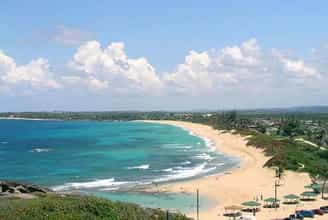
Tra Co Beach is one of the most beautiful coastlines in Quang Ninh with a length of up to 15km. Tra Co Beach is located about 8km from Mong Cai city and about 200km from Ha Long city. Tra Co is famous for its beautiful natural space, cool blue water and golden sand. Tra Co Beach is one of the most beautiful coastlines in Quang Ninh with a length of up to 15km. Tra Co Beach is located about 8km from Mong Cai city and about 200km from Ha Long city. Tra Co is famous for its beautiful natural space, cool blue water and golden sand. Beach tourism is definitely the best in summer. At Tra Co beach, the most ideal time will be from April to July. This time Tra Co beach will bring a super beautiful landscape with clear water, gentle waves, not too heavy, so it is very suitable for swimming. For those of you who want to experience the festivals at Tra Co beach, remember to come here between May 25 and June 6 of the lunar calendar. At this time, many interesting activities will take place such as the God Procession Ceremony, the Boat Procession Ceremony, the Elephant Procession Ceremony,... Visiting Tra Co beach, surely the first thing everyone wants to do is immerse themselves in the clear blue water of this place. Tra Co Beach makes a deep impression with its pristine scenery, blue sea water, and gentle waves throughout all seasons, making many tourists remember it forever. The beauty under the sea on the shore is even more wonderful, with fine white sand beaches, many green casuarina trees or blue morning glory strips creating an extremely wonderful scene. In the early morning or late afternoon, Tra Co beach also entertains visitors with extremely beautiful sunrise and sunset views. At this time, you will clearly see Tra Co beach as if it is wearing a completely new coat. Especially the sunset scene, both brings mesmerizing beauty and creates a feeling of regret when admiring. Da Den Beach, also known as Ngoc Son beach, is a beach located quite close to Tra Co beach. As the name suggests, Da Den beach possesses many black rocks with diverse shapes from small to large. They lie next to each other on the sandy shore, creating a scene that is both mysterious and attractive. Besides, Da Den beach also has a smooth white sand beach, blue water and beautiful wild scenery. Coming here, you will also find super beautiful check-in corners.
Quang Ninh
7525 view
April to July
 AI Travelviet